
Connect in this order, red to the dead battery, red to the good battery, black to the good battery, then black to bare metal on the dead car, away from the battery. Remove them in the exact reverse order.
A dead battery is the most common way people get stuck. A jump gets you home. Doing it in the wrong order can make sparks right next to a battery, and batteries can give off gas that burns.
So we go slow, and we go in order. Read the whole lesson once before you touch a clamp.
What You Need
- Jumper cables, or a charged portable jump pack
- A working car with a battery of the same voltage, almost always 12 volt
- Safety glasses and gloves, if you have them
- A flashlight
- Your owner's manual
Safety First
- Do not jump a battery that is cracked, leaking, bulging or frozen. Call for help instead.
- Check your owner's manual. Some cars have remote jump posts under the hood, and many hybrids and electric cars have their own rules about jumping or being used to jump another car.
- No smoking or flames near the battery. Wear eye protection if you can.
- Never let the red and black clamps touch each other once any clamp is connected.
- Keep cables away from fans and belts. Some fans can start on their own.
Jumper Cable Order
On in order one, two, three, four. Off in reverse, four, three, two, one.
Step by Step
Park the Cars and Shut Them Off
Pull the good car close, nose to nose or side by side, but do not let the cars touch. Put both in Park, or in gear for a manual, and set both parking brakes. Turn both cars off. Turn off lights, radio and fan on the dead car.
Find the Terminals
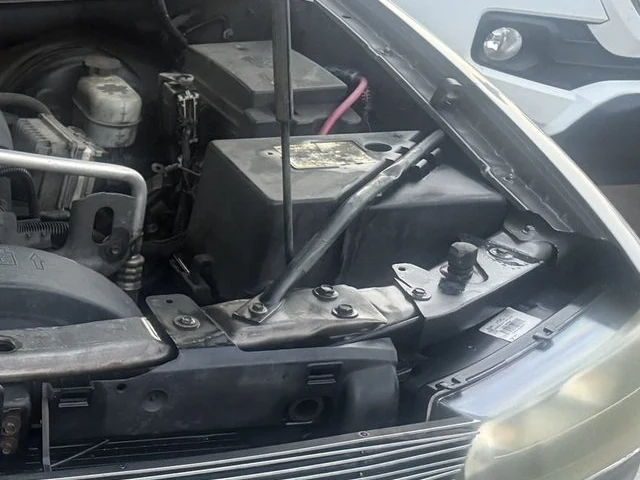
Open both hoods. Find each battery, or the jump posts your manual shows. The positive terminal is marked + and often has a red cover. The negative is marked minus. If a terminal is crusty with white or green buildup, a good clamp grip matters more.
Clamp One, Red to the Dead Battery
Connect one red clamp to the positive terminal on the dead battery. Wiggle it so it bites onto metal.
Clamp Two, Red to the Good Battery
Connect the other red clamp to the positive terminal on the good battery.
Clamp Three, Black to the Good Battery
Connect one black clamp to the negative terminal on the good battery.
Clamp Four, Black to Bare Metal
Connect the last black clamp to a ground point A bare, unpainted metal bolt or bracket on the engine or frame. It gives the last jumper clamp a safe place to connect away from the battery. on the dead car. That is a bare, unpainted metal bolt or bracket on the engine, away from the battery and away from moving parts. Your manual may show one. This keeps any spark away from the battery.
Start the Good Car
Start the good car and let it run for a few minutes. This puts some charge into the dead battery.
Start the Dead Car
Try to start the dead car. If it does not start, wait a few more minutes and try again. Do not crank for more than a few seconds at a time. If it still will not start after a few tries, stop. Something else may be wrong.
Remove Cables in Reverse
With both cars running, take the clamps off in reverse order. Black from the bare metal, black from the good battery, red from the good battery, then red from the formerly dead battery. Keep the clamps apart as you go.
Drive to Recharge
Drive the car for at least 20 to 30 minutes, ideally not in stop and go traffic. If the car dies again soon, the battery or the charging system needs to be tested.
When to Stop and Call a Pro
- The battery is cracked, leaking, swollen or smells like rotten eggs.
- The car clicks but will not start after a few tries, or nothing happens at all.
- The car starts but dies again within a day or two. The battery or alternator needs a test.
- The battery light stays on while you drive.
- You drive a hybrid or electric car and the manual does not clearly show how to jump it.
No shame in it. Knowing when to stop is part of the skill. Find a mechanic near you on MechanicRank.
Questions People Ask
What order do jumper cables go on?
Red to the dead battery positive, red to the good battery positive, black to the good battery negative, then black to bare metal on the dead car. Take them off in the exact reverse order.
Why not put the last black clamp on the dead battery?
The last connection can make a small spark. A battery can give off gas that burns. Putting that last clamp on bare metal away from the battery keeps the spark away from the gas.
Can a jump-start damage my car?
Done in the right order with the right cables, it is very unlikely. Hooking the cables up backward can damage electronics, which is why you go slow and check plus and minus twice.
Is a portable jump pack better than cables?
It is handy because you do not need a second car. Follow the instructions on the pack. Most use the same idea, red to positive and black to ground.
How long should I drive after a jump?
At least 20 to 30 minutes. A battery that went dead may need a full charge from a charger, and a test to see if it is still good.